English
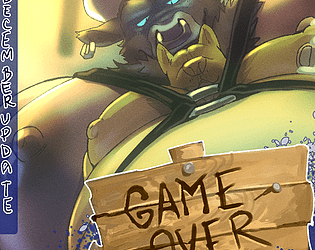
GameOver places you in a small, uncanny town where a looping, dreamlike mystery unfolds and only your character keeps memories between episodes. In GameOver you wake up after arriving in this place to find rumors, odd behavior from residents, and repeating events that seem to reset for everyone except you. The opening hours prioritize exploration and conversation over action, and the game balances narrative investigation with a compact stat system so choices feel consequential as the plot slowly reveals itself.
The core gameplay of GameOver combines free exploration with scripted encounters and a few light resource-management mechanics. Your character is governed by three visible stats — Health, Stamina and Lust — that influence how you perform tasks, whether you can travel quickly across the map, and how NPCs react to certain interactions. Investigation unfolds through branching conversations, item discovery and scene triggers; progress is driven by learning which scenes lead to new clues and how your remembered decisions change outcomes in later loops. Combat is minimal and contextual rather than central, while character-driven encounters and dialogue choices steer the story in multiple directions.
Controls are designed for touch screens and simple taps: tap to move, tap characters or objects to interact, and use an on-screen menu to manage inventory and check stats. Dialogues use choice wheels or buttons that clearly show possible consequences when available, and the interface keeps important information like current Health and Stamina visible during exploration. The experience emphasizes readability and clarity so players can focus on story choices rather than complex input. Tooltips and a brief interactive tutorial help new players learn mechanics without interrupting the tone of the game.
Progression in GameOver is driven by the memory-loop structure: each episode grants new information that opens previously inaccessible scenes or conversation branches, while completing tasks can improve access to work options, locations and NPC favor. The game features optional paid content and supporter tiers that unlock additional scenes and expanded scenarios; these extras are clearly labeled and do not block the main narrative, allowing players to enjoy the base experience offline. A modest in-game shop offers purchasable expansions for players who want more material, and the description in the store explains what is included in each tier before purchase.
The town in GameOver is deliberately small but densely written, with visually consistent areas such as a central square, late-night bars, back alleys and residential streets that each host unique scenes. Art direction leans toward moody, atmospheric visuals with muted palettes and character portraits that emphasize emotion rather than realism. Levels are structured as a network of locations that you can revisit across loops; certain scenes only trigger at particular times or after specific choices, which encourages careful observation and methodical exploration of the map.
Customization focuses on player convenience and readability rather than deep character editing: adjustable text size, color-contrast options, and a simplified control mode let players tailor the UI to their needs. Players can also toggle difficulty-like settings that affect resource scarcity and how quickly certain stats drain, allowing those who prefer a relaxed narrative pace to reduce pressure and those seeking challenge to manage tighter trade-offs. The game keeps mature content descriptions upfront so players can make informed choices about what to engage with.
Replayability is central to the design: because only the player retains memories between loops, decisions open alternative routes and change how NPCs behave, which encourages multiple playthroughs to uncover different endings and scenes. The stat-driven mechanics create tactical trade-offs — choosing to expend Stamina to reach a scene faster, for example, may leave you vulnerable later — and optional difficulty adjustments let players increase or decrease the intensity of those resource decisions. Challenges arise from managing limited resources, deciding which leads to follow, and piecing together the town’s underlying mystery.
GameOver is playable offline once installed and saves progress between sessions so you can return to your investigation at any time. Regular updates add supporter content and bug fixes; the latest version includes additional scenes available through supporter tiers and in-app purchases, and patch notes in the store describe those additions in detail. The description here aims to set clear expectations about adult themes and purchasable extras while allowing new players to understand the mechanics and atmosphere before they install.
Aura of Sin
Size:1189.32M CasualSDT:remix
Size:177.98M CasualThe Price of Ambition
Size:903.53M CasualSpanking Ass-v0.0.8!Uplate!!!
Size:25.69M CasualThe Hidden Spectrum
Size:661.35M CasualGrim Girl
Size:93.21M CasualWhen We Faded
Size:545.18M CasualPent Up Willowford
Size:223.27M CasualRealm of Evergrow
Size:401.40M CasualDyseros
Size:984.42M CasualJunes University Story
Size:14.65M CasualOwnMe Kira
Size:231.25M CasualApril 2024 Clash of Clans Update: Unveiling a Fresh Companion, Enhanced Levels, Chat Tagging, and Be
2024-04-16Arrival of Genshin Impact 4.6 Update: 'Embers of Two Realms, Twilight of Crimson'
2024-04-16V2.2 of the Farlight 84 update introduces an overhauled Season structure, fresh in-game currency, an
2024-04-16Monster Never Cry is now accessible on both Android and iOS mobile devices.
2024-04-18PUBG Mobile Teams Up with Bentley Motors: Luxury Cars, Exclusive Collectibles, and Beyond
2024-04-18March 2024 Free Redemption Codes for Honkai: Star Rail
2024-04-18