English
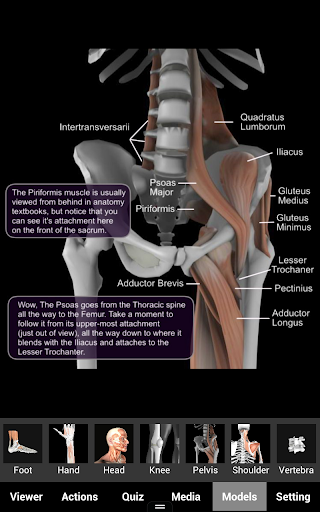
Muscle and Bone Anatomy 3D is a detailed, interactive reference for the human musculo-skeletal system that combines an intuitive 3D viewer, action animations, focused anatomical models and a variety of quiz formats to support study for students and clinicians. This app places labeled hotspots directly on high-resolution 3D anatomy so users can inspect 145 muscles, view origins and insertions, check nerve supply, and explore bone landmarks with explanatory notes. The description below explains how the app works, what to expect from the visual and learning systems, and practical considerations for use in classroom and clinical review.
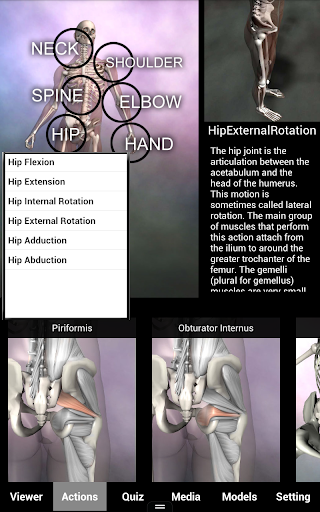
The core viewer provides full three-dimensional control over the body model using standard touch controls: pinch to zoom, drag to rotate, and tap to open full-screen images for each structure. Muscle and Bone Anatomy 3D includes 145 muscle entries and detailed bone landmark pages, an Actions section that animates over 37 body movements, and seven focused 3-D models covering the ankle, knee, pelvis, shoulder, face, hand and vertebrae. Media content supplements the models with thirty pages of foundational information and five short embedded videos totaling approximately 16 minutes, giving concise summaries of arm, torso, face, leg and fascia anatomy.
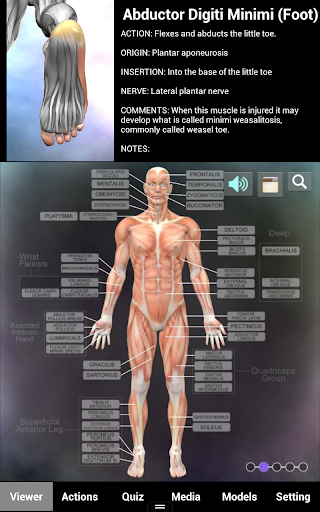
The app's interactive hotspots are designed for rapid reference: tap a labeled hotspot to read a short, clinically oriented entry listing name, action, origin, insertion and nerve supply, plus a brief comment that clarifies function. Action animations group muscles by movement so you can see which muscles contribute to a specific action, and the model stops in the 3-D modules identify regional structures in sequence for focused study. A multiple-choice quiz builder lets you create targeted tests by selecting question type and anatomical region, while adaptive quizzing automatically tracks missed items and adds them to Favorites for concentrated review.
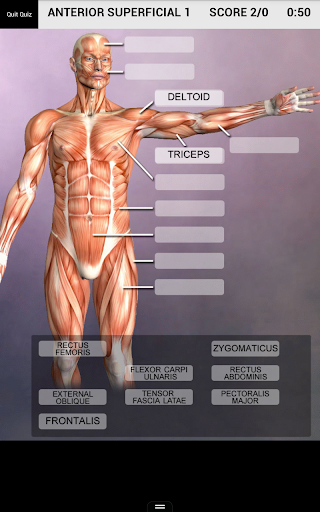
Study progression in Muscle and Bone Anatomy 3D is driven by repeated exposure and targeted assessment rather than linear levels. Users progress by mastering individual muscle entries and actions, increasing difficulty through custom quizzes and the adaptive system that cycles missed items back into practice. The app offers label-matching pages and spelling quizzes to reinforce recall, a skeletal quiz for bony landmarks, and a general anatomy exam for broader review. Scores can be emailed for personal tracking or to share with instructors, offering a simple way to monitor improvement over time.
Controls are optimized for touch devices with clear, discoverable gestures and full-screen image views for detailed inspection. Customization centers on the quiz builder and Favorites list: build region-specific quizzes, choose which attributes to test (name, action, origin, insertion) and mark structures for repeated practice. Replay value arises from varied quiz formats, adaptive review of missed items, and the breadth of structures included, which supports both short refreshers and extended study sessions across multiple anatomy topics.
The visual presentation emphasizes clarity and clinical relevance with high-resolution imagery and labeled hotspots that avoid clutter. Focused 3-D models include multiple 'stops' to guide attention through complex regions, and explanatory comments are kept concise so they work as quick clinical references as well as study notes. Animations illustrating actions are deliberately simple so movement patterns are easy to follow without distracting visual effects.
The interface is intended to work across phones and tablets, though the full interactive experience is most comfortable on larger screens where labels and hotspots are easier to manipulate. The app is structured for self-paced study in classroom, lab or clinical contexts and supports offline use for hands-on review when network access is limited, since core models and quizzes are accessible without streaming. Control sensitivity and label legibility have been tuned to minimize accidental selections and to help users with different dexterity levels.
While Muscle and Bone Anatomy 3D provides comprehensive musculo-skeletal detail, it focuses narrowly on muscles, bones and their relationships and does not substitute for cadaver dissection or supervised clinical training. Smaller phone screens may feel cramped for detailed model exploration, and the app does not include other body systems in depth. Nonetheless, it serves as a practical, interactive supplement for coursework, lab preparation and quick clinical review.
Pizzaria do Erick
Size:19.12M LifestyleMy Hurricane Tracker Pro
Size:4.73M LifestylePushscroll
Size:61.25M LifestyleSmartWOD Timer
Size:26.75M LifestyleMeteum Weather
Size:63.84M LifestyleBestifyMe
Size:13.80M LifestyleWeatherPro
Size:48.30M LifestyleEmpower You: Unlimited Audio
Size:80.20M LifestyleAdobe Express
Size:107.80M LifestyleGeoZilla
Size:63.92M LifestyleONEWallet - Cards Wallet
Size:15.00M LifestyleFloor Plan Creator Home Design
Size:40.91M LifestyleApril 2024 Clash of Clans Update: Unveiling a Fresh Companion, Enhanced Levels, Chat Tagging, and Be
2024-04-16Arrival of Genshin Impact 4.6 Update: 'Embers of Two Realms, Twilight of Crimson'
2024-04-16V2.2 of the Farlight 84 update introduces an overhauled Season structure, fresh in-game currency, an
2024-04-16Monster Never Cry is now accessible on both Android and iOS mobile devices.
2024-04-18PUBG Mobile Teams Up with Bentley Motors: Luxury Cars, Exclusive Collectibles, and Beyond
2024-04-18March 2024 Free Redemption Codes for Honkai: Star Rail
2024-04-18