English
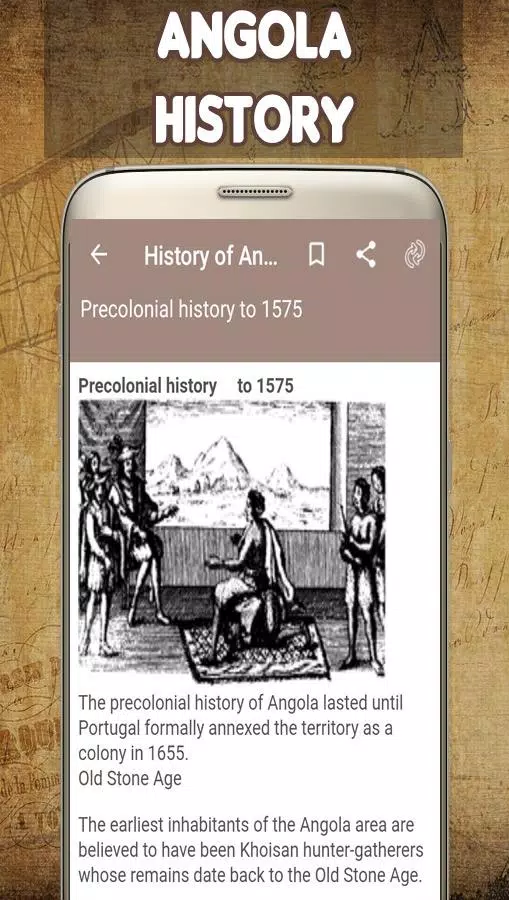
History of Angola is a focused educational app that brings Angola's past into a compact, searchable format for students, teachers, journalists, and curious readers. History of Angola combines illustrated timelines, layered historical maps, curated articles and primary-source excerpts to help users form a clear picture of pre-colonial societies, colonial administration, the independence era and contemporary developments. The app is designed for study at home, reference in the classroom, or research in the field, and it supports offline use when connectivity is limited.
The app structures content into progressive modules that behave like learning levels: introductory overviews, intermediate thematic essays, and advanced source-based dossiers. Each module lists learning objectives and suggested reading paths so users can follow a guided progression or jump directly to topics of interest. Progress tracking records completed readings, quiz performance and flashcard mastery so learners can see measurable improvement and return to weak topics. These progression elements give the app a study-like flow without turning scholarship into a game.
History of Angola features an interactive timeline that users navigate with simple touch controls: pinch to zoom, drag to shift decades, and tap entries to open concise summaries. Timeline entries expand into full articles and illustrations, and embedded media plays inline without interrupting navigation. Map interactions use layered toggles to reveal changing borders, trade routes and settlement patterns; users can pan and zoom maps smoothly on phones and tablets. The control set remains minimal by design so navigation stays intuitive for first-time users and experienced researchers alike.
The visual style favors clarity and legibility over decoration: high-contrast typography, thoughtfully sized headings, and image captions that connect visuals to narrative. Map layers use distinct color palettes to communicate historical periods, while icons mark primary-source documents, biographies and gallery items. Adjustable text size, dark mode and line spacing settings allow readers to tailor the interface for long study sessions or quick lookups, improving comfort across different lighting conditions and device sizes.
Built-in study features include a glossary, flashcards generated from article highlights, and several quiz modes. Quizzes range from multiple-choice to timeline-ordering exercises and include optional timed rounds for self-challenge. The spaced repetition algorithm on flashcards helps retention over repeated sessions, and bookmark collections let users assemble custom reading lists for review. Regular content updates and editable study lists create replay value: users can revisit modules as new materials are added or as they prepare for specific assignments.
The app hosts a layered library with short summaries for quick reference and longer, annotated articles for deeper study. Each article includes bibliographic references and, when available, links or scans of letters, treaties and official reports. Filters let users sort by period, theme or region, and cross-references guide readers from a biography to related events, maps or primary documents. This structure supports both quick fact-checking and more sustained archival research.
Users can create profiles to save bookmarks, flashcard progress, and quiz history. Educators may assemble and export reading lists or share collections with students via a generated link or QR code for offline distribution. Notes and highlights can be exported in common citation formats, and preference settings include a default citation style to streamline preparation of bibliographies for essays or reports.
For fieldwork or travel, History of Angola provides downloadable offline packages that store core articles, maps and images locally. Users choose package size to balance storage needs and content depth; the app automatically adjusts media quality for older devices while offering higher-resolution assets for modern hardware. Cached searches and lightweight indexing speed up access to frequently viewed entries without network delays.
Recognizing Angola’s multilingual environment, the app supports multiple interface languages and offers translated article summaries. Accessibility features include text-to-speech, screen reader compatibility, adjustable contrast and descriptive captions for images. These accommodations ensure that users with different abilities or language preferences can navigate content and engage with source material effectively.
Content is updated periodically to reflect new scholarship and community feedback. A moderated contribution system allows qualified historians and educators to suggest edits or submit articles for editorial review. Designed for lifelong learners, classroom instructors and journalists, History of Angola aims to be a reliable, searchable companion for understanding Angolan history, offering both quick references and pathways to deeper research.

Bangla Quran
Size:13.14M News & MagazinesWAZ News
Size:24.20M News & MagazinesThe Daily Telegraph
Size:94.80M News & MagazinesBookmory - reading tracker
Size:9.34M News & MagazinesComic Reader CBR, CBZ & PDF
Size:97.80M News & MagazinesGalatea: Books & Audiobooks
Size:166.69M News & MagazinesOxford Dictionary of English
Size:92.33M News & MagazinesTimes Of India
Size:26.12M News & MagazinesLife Bible
Size:147.10M News & MagazinesRabbana Duas from Quran
Size:37.50M News & MagazinesFizika(Maktab darsliklari)
Size:191.20M News & MagazinesDavid Jeremiah Devotional
Size:13.00M News & MagazinesApril 2024 Clash of Clans Update: Unveiling a Fresh Companion, Enhanced Levels, Chat Tagging, and Be
2024-04-16Arrival of Genshin Impact 4.6 Update: 'Embers of Two Realms, Twilight of Crimson'
2024-04-16V2.2 of the Farlight 84 update introduces an overhauled Season structure, fresh in-game currency, an
2024-04-16Monster Never Cry is now accessible on both Android and iOS mobile devices.
2024-04-18PUBG Mobile Teams Up with Bentley Motors: Luxury Cars, Exclusive Collectibles, and Beyond
2024-04-18March 2024 Free Redemption Codes for Honkai: Star Rail
2024-04-18